disableRclick

Thursday, 10 December 2020

Summer 2018

 June

The sward is knee-high now:

Looking south towards block A (June 2018)

 June is the month when you really start to get a strong visual expression of the diversity in these limestone grasslands.  Even in early June, the sward is thickly dotted with a rich variety of flower colours, sizes and shapes.  


There is a good show of some of the less commonly considered flowers found in calcareous grasslands, including those of broomrapes and grass species.  Although they are superficially reminiscent of orchids, broomrapes are parasitic species that don't contain any chlorophyll, and so are unable to photosynthesise.  They get their nutrition by tapping in to the roots of other plant, often strongly restricted to specific host plants such as knapweed, ivy and some grass species.

Broomrape
Pyramidal orchid

Grasses are wind-pollinated, and produce a huge amount of pollen - this makes working in grasslands in summer a real trial if you (like me) suffer from hayfever.


By late June, the colour and structure of the sward had changed again, and was becoming dominated by seeding bodies rather than flower organs.  This is the stage that the biomass harvest is taken, in order to assess the influence of the experimental manipulations (rainfall and nitrogen addition) on the  productivity of the functional (plant) groups. 


Looking east; block B is nearest, block C is at distance. June 2018.

The June surveys and biomass harvests conclude the data collection I am doing for my PhD, though RainDrop will continue to run, and will continue to be monitored to build a long-term dataset for this plant community.  

 Collecting data is only one part of this kind of research - albeit arguably the most enjoyable aspect - and I now move into the next step, which is the deeper analysis of the data, and the development of credible interpretations of what that data is telling me. I have a strong impression that the vegetation on site is distinctly different to how it was when I first arrived, over three years ago, and an equally strong impression of differences between rainfall treatments.  Once I have tackled some of the analysis, I hope to be able to describe those differences in a more objective way!  

 More on that later.... for now, I'm just happy to have been able to spend so much time in this very special corner of the UK, in this very special habitat.  I've even learned to ID some grass species!


Spring 2018

 March 

The roof panels have been turned over, and I'm back on site despite there still being snow on the ground here and there.  It's been a long, wet winter and isn't very warm up here today; I'm grateful for my toasty hat, and a flask of tea (nectar of the fieldworker!). 


The wet weather from Autumn last year meant that the Wytham staff couldn't get onto site to do the end of season cut until really late, so there's not been much regrowth yet (though not a lot would be expected over winter).  It's very quiet on site - just me, some crows, and, despite still being rather nippy, rather a lot of snails.


Taking a walk around the perimeter and revelling in being back, I spotted this striking parasitic wasp.  This is definitely one to check on for an ID when I get back into the warm - though I'll probably need specialist input, as I'm really rusty now on these impressive-looking insects.  


April

Not so much April showers, as April fog...

Looking south towards blocks A (right) and B (left).  April 2018
 

Still not much regrowth, though there are some small flowers making a show - violets and cowslips nudge up towards the weak spring sunshine.


May

May saw me mostly engaged in a survey of calcareous grasslands from Somerset up to County Durham (a bit intense, but totally enjoyable work), but I did find time to call in to RainDrop in mid May, and what a difference a month (and some blue skies and sunshine) makes!  Some strong regrowth lends the site a rich green mantle - look at the difference between this and a similar shot in April (above):

Looking south towards blocks A (right) and D (in the distance to the left).  May 2018.

Plenty of Spring flowers stud that green sward now:


Monday, 8 January 2018

We go to Ghent

A shot-in-the-dark application to BES resulted in the offer of a poster presentation slot at the 2017 Ecology Across Borders conference in Ghent in December.

This proved to be a huge conference, with over 1,000 delegates, and trade and information stands covering everything from remote sensing, publications, butterfly nets, citizen science and, of course, the BES. A great opportunity to meet old colleagues and make new friends, and to find out about some of the great science they are involved with (and to tell them about my own small contribution to scientific knowledge).

My poster!


Happy New Year!

Thursday, 12 October 2017

Above ground, below ground


Most of my data collection is concerned with what's going on above ground - which plants are growing where, and how productive they are.  Although the sward is perhaps the most immediately obvious feature of a grassland, it's just the tip of the iceberg, and there's a lot of activity going on out of sight on which the familiarly green upstanding parts depend.  Not only the underground parts of plants themselves, but also soil organisms work the soil like tiny miners, allowing air to flow in and water to flow out, and burying organic matter, where it is broken down by a myriad of soil fauna and flora.

One group of organisms that help tie together the above and below ground worlds are the fungi, and Autumn is when their presence is made visible to even the casual observer, as their fruiting bodies push up through turf and litter.  Though the visible stage in the lifecycle is often ephemeral, fungi play a crucial role in grassland ecosystem functions: their role as decomposers is an important part of the carbon and other nutrient cycles; they themselves provide a food source for other organisms (insects, small mammals, etc); and they facilitate nutrient uptake in plant roots.  Grassland fungi are vulnerable to physical and environmental disturbance, being often sensitive to such as nutrient input in the form of fertiliser, and so are declining in many semi-improved and improved grasslands.

Inspired by Sean Cooch of Natural England, and his presentation on waxcap grasslands at the Grasslands conference in August, I thought I'd see what the fungal offering was at Upper Seeds, and how many different macro fungi I could spot as I went about my other tasks on site.  Apart from making a change from looking solely at forbs, it would be a useful exercise as fungi can be used as indicators of unimproved grassland quality, so the more I find of the right kind, the further the site draws away from its semi-improved past.

So, what are the right kind of fungi, that I was looking for?  The best and brightest are the waxcaps (Hygrocybe genus), that favour short swards on undisturbed, infertile soils..  Waxcaps are a group of grassland fungi known to be in serious decline, and waxcap grassland habitat is now recognised for its conservation value for mycological diversity.  There's lots of information about waxcaps, their habitat and requirements on Aberystwyth University's Waxcap Website , and English Nature's research report on waxcap grasslands can be found here:  ENRR555 Waxcap grasslands

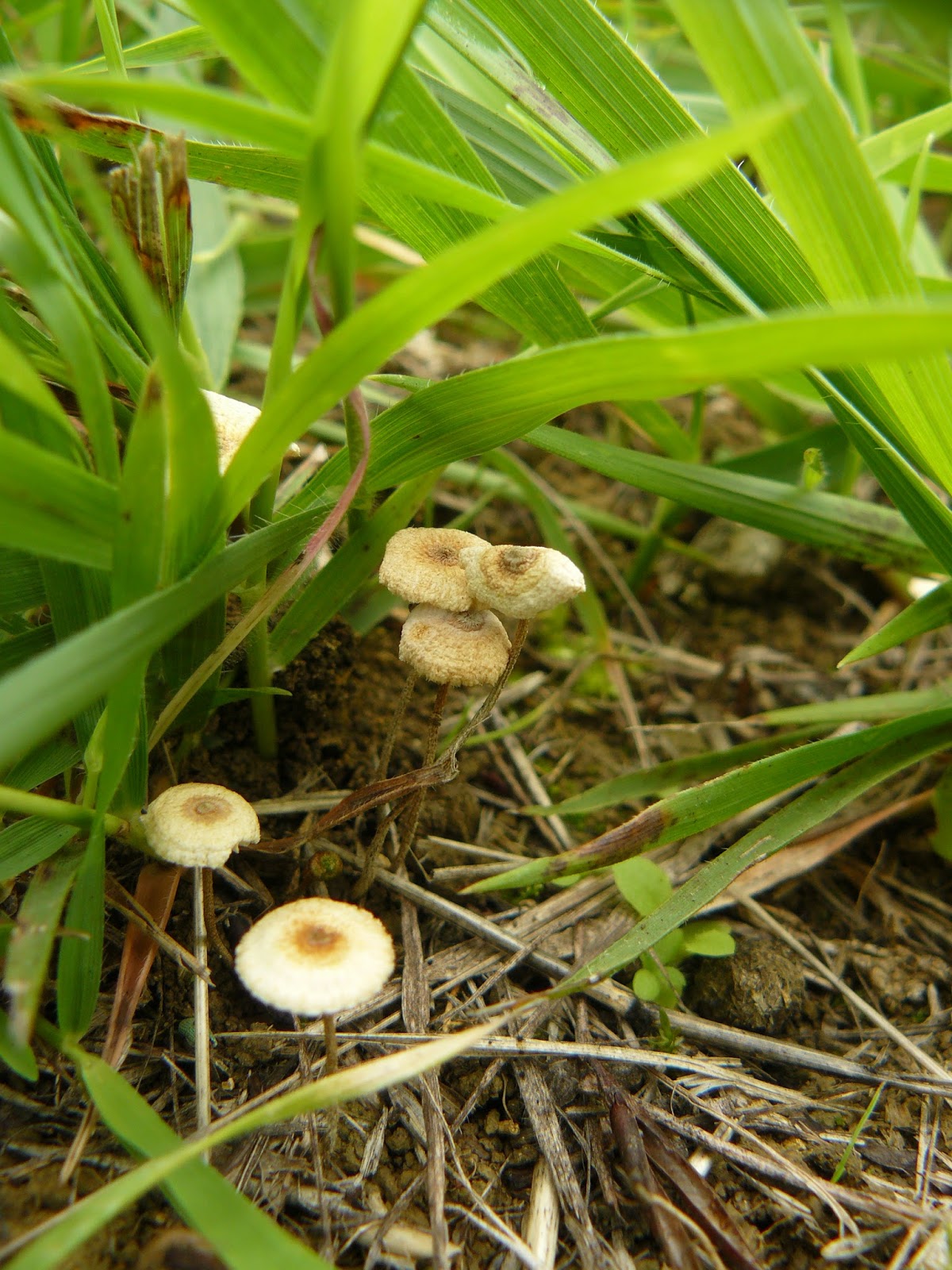
This is a selection of the fungi I spotted in one day on site:  any IDs would be very welcome, as I hesitate to even start down that road just at present (the green herbaceous  things are keeping me far too busy for that!).


Friday, 29 September 2017

Fisticuffs - Wytham's sparring spiders


Slappy spider colonists on one rain shelter come to blows yesterday - well, pokes, anyway 😉 


Just passing through.....

As I sat writing up my notes and enjoying the quiet earlier on site this week, I was pleased to see a couple of swallows alight on the overhead wires......


then there were three......

then quite a few......

and suddenly there was in excess of 60 chittering chattering swallows swooping around me as they scooped up insects to fuel the long journey ahead, all the way down to South Africa. 


Then on a sudden, they were all up and gone. 

Marvellous to be able to just be there and experience that!  (I did try videoing them, but really, it was a lot of small specks in a big sky, as you can imagine.  You really had to be there!)


Friday, 1 September 2017

Mists and mellow fruitfulness

Keats' vision of Autumn was a tad warmer and drier than the other day: a very misty vista across the site - a chill in the air, and a fine grey wetness over everything cast thoughts of the summer behind me.  Even the buzzard seemed diminished by the cool grey damp, and sat calling most mournfully from its perch at the top of the telegraph pole.

Buzzard on the look-out for breakfast on a foggy morning

The summer hay cut has been made across the whole field, which has changed the appearance of the sward (and so, of course, the whole site) immensely - no longer a flower-rich meadow of waving grasses studded with colour and humming to the summer song of bees, it's low, green and rather wet underfoot, as the plants start to cut back production, and the bees slowed down by the cooling days.  This bumblebee (B. pascuorum) was very  v e r y slow, and sat on the scabious flowerhead looking rather damp for at least half an hour.  

Bumblebee Bombus pascuorum waiting to warm up

As the mist lifted, a brief break in the clouds let some sunshine in, and that touch of warming sun meant more insects were on the wing making the most of the day.  The flowers may be mostly gone from the field, but there's fruit aplenty in the bushes and scrubby field margins - hawthorn bushes offer up their own ruby-red berries, and support scrambling brambles heavy with tender sweet sugary blackberries.

Wasps go crazy for blackberries - thorns AND stings to watch out for when picking my lunch! The Marmalade Fly (Episyrphus balteatus) maybe fancying some bramble jam
These small winged creatures actually catch the eye by virtue of their movement; softer-bodied, more slow-moving residents in the field rely on camouflage to avoid predation: snails frequently rest partway up plant stems, and Lepidoptera larvae use colouring and posture to fade into their immediate background.
Kentish snail taking a break
Pug moth caterpillar on ragwort
Beetles were also out and about - an upturned chair (to prevent rainwater puddles, which are unpleasant to sit in!) provided shelter for a number of woodlice and these rove (staphylinid) beetles, which have a bright red pronotum and basal abdominal segments.  Their bright colouring may be warning indicators; the Paederus genus (which these may belong to) produce toxins associated with irritant dermatitis (Nasir et al. (2015) biomedcentral). 

Rove beetles hiding out under my chair
After seeing the hundreds of Harlequin Ladybirds (Hormona axyridis) that emerged from overwintered pipework and other hardwares, it's been satisfying to see some of our native ladybirds on site.  We have over forty native species (remember the downy 24-spot ladybird (Subcoccinella 24-punctata) from May's post last year? Spring comes to Upper Seeds)
Native Seven-spot Ladybird (Cocchinella septempunctata) munching on late aphids

The Harlequins have been named the most invasive ladybird in the world (ladybird survey website), and have spread across the whole of the south and midlands of England, and into northern counties, since they were first recorded in 2004 in the UK.  They can outcompete our native ladybirds, and will take eggs, larvae and pupae of other insects, including other ladybirds, butterflies and moths.
Harlequin ladybirds emerging into the Spring sun, 2017
 So there you are - a few observations from a changing field.  Many of the features that we think of when picturing a lowland grassland have gone or are fading as the year's page turns towards another season, but there's still plenty of activity on site.  A taste of things to come...