disableRclick

Friday, 29 September 2017

Just passing through.....

As I sat writing up my notes and enjoying the quiet earlier on site this week, I was pleased to see a couple of swallows alight on the overhead wires......


then there were three......

then quite a few......

and suddenly there was in excess of 60 chittering chattering swallows swooping around me as they scooped up insects to fuel the long journey ahead, all the way down to South Africa. 


Then on a sudden, they were all up and gone. 

Marvellous to be able to just be there and experience that!  (I did try videoing them, but really, it was a lot of small specks in a big sky, as you can imagine.  You really had to be there!)


Friday, 1 September 2017

Mists and mellow fruitfulness

Keats' vision of Autumn was a tad warmer and drier than the other day: a very misty vista across the site - a chill in the air, and a fine grey wetness over everything cast thoughts of the summer behind me.  Even the buzzard seemed diminished by the cool grey damp, and sat calling most mournfully from its perch at the top of the telegraph pole.

Buzzard on the look-out for breakfast on a foggy morning

The summer hay cut has been made across the whole field, which has changed the appearance of the sward (and so, of course, the whole site) immensely - no longer a flower-rich meadow of waving grasses studded with colour and humming to the summer song of bees, it's low, green and rather wet underfoot, as the plants start to cut back production, and the bees slowed down by the cooling days.  This bumblebee (B. pascuorum) was very  v e r y slow, and sat on the scabious flowerhead looking rather damp for at least half an hour.  

Bumblebee Bombus pascuorum waiting to warm up

As the mist lifted, a brief break in the clouds let some sunshine in, and that touch of warming sun meant more insects were on the wing making the most of the day.  The flowers may be mostly gone from the field, but there's fruit aplenty in the bushes and scrubby field margins - hawthorn bushes offer up their own ruby-red berries, and support scrambling brambles heavy with tender sweet sugary blackberries.

Wasps go crazy for blackberries - thorns AND stings to watch out for when picking my lunch! The Marmalade Fly (Episyrphus balteatus) maybe fancying some bramble jam
These small winged creatures actually catch the eye by virtue of their movement; softer-bodied, more slow-moving residents in the field rely on camouflage to avoid predation: snails frequently rest partway up plant stems, and Lepidoptera larvae use colouring and posture to fade into their immediate background.
Kentish snail taking a break
Pug moth caterpillar on ragwort
Beetles were also out and about - an upturned chair (to prevent rainwater puddles, which are unpleasant to sit in!) provided shelter for a number of woodlice and these rove (staphylinid) beetles, which have a bright red pronotum and basal abdominal segments.  Their bright colouring may be warning indicators; the Paederus genus (which these may belong to) produce toxins associated with irritant dermatitis (Nasir et al. (2015) biomedcentral). 

Rove beetles hiding out under my chair
After seeing the hundreds of Harlequin Ladybirds (Hormona axyridis) that emerged from overwintered pipework and other hardwares, it's been satisfying to see some of our native ladybirds on site.  We have over forty native species (remember the downy 24-spot ladybird (Subcoccinella 24-punctata) from May's post last year? Spring comes to Upper Seeds)
Native Seven-spot Ladybird (Cocchinella septempunctata) munching on late aphids

The Harlequins have been named the most invasive ladybird in the world (ladybird survey website), and have spread across the whole of the south and midlands of England, and into northern counties, since they were first recorded in 2004 in the UK.  They can outcompete our native ladybirds, and will take eggs, larvae and pupae of other insects, including other ladybirds, butterflies and moths.
Harlequin ladybirds emerging into the Spring sun, 2017
 So there you are - a few observations from a changing field.  Many of the features that we think of when picturing a lowland grassland have gone or are fading as the year's page turns towards another season, but there's still plenty of activity on site.  A taste of things to come...

Friday, 18 August 2017

Grassland conservation conference 2017 - and a bit of trumpet-blowing

There's nothing like a bit of recognition to put a smile on your face!

Recently returned from the inaugural Grassland Conservation conference, hosted and organised by conservation research colleagues at Edge Hill university.  @upland_grazing  @biologyehu

Keynote speaker Richard Jefferson set the scene for a mixed group of people from widely varied backgrounds, and enthusiastic chairing successfully promoted relaxed discussions on topics from grassland invertebrate biodiversity, the need for a national ancient grasslands database, and how to improve interaction and engagement between academics, other researchers, practitioners and the public. 

Day Two comprised grassland management workshops - I opted for the upland calcareous one, involving a site visit to Ingleborough NNR in North Yorkshire, to see upland grassland management on limestone pavement sites in action; seems that cattle are more appropriate for this kind of habitat, as sheep graze-out the tasty forbs in the nooks and crevices of the pavement, but cattle tend to graze around the edge of the exposed limestone.

Mixed cattle including Red Poll and Shorthorns graze the upland calcareous grasslands at Ingleborough NNR

Limestone pavement provides sheltered nooks and crannies for rare and specialist plant species
  All in all, a really interesting and enjoyable couple of days, topped off by winning the poster prize, sponsored by the Sir George Stapledon Memorial Trust - forgive the rather mad expression, I can only say I was completely (but pleasantly) surprised!

Stephen Peel, Trustee of the Sir George Stapledon Memorial Trust, my poster, and a rather surprised me!


In my opinion, the conference was a great success, and I would heartily recommend it to anyone interested in grassland conservation - either for research or practical management - and hope to attend future events.  A really comfortable and friendly conference indeed. 

Thursday, 18 May 2017

Spring cleaning and gearing up for a new year

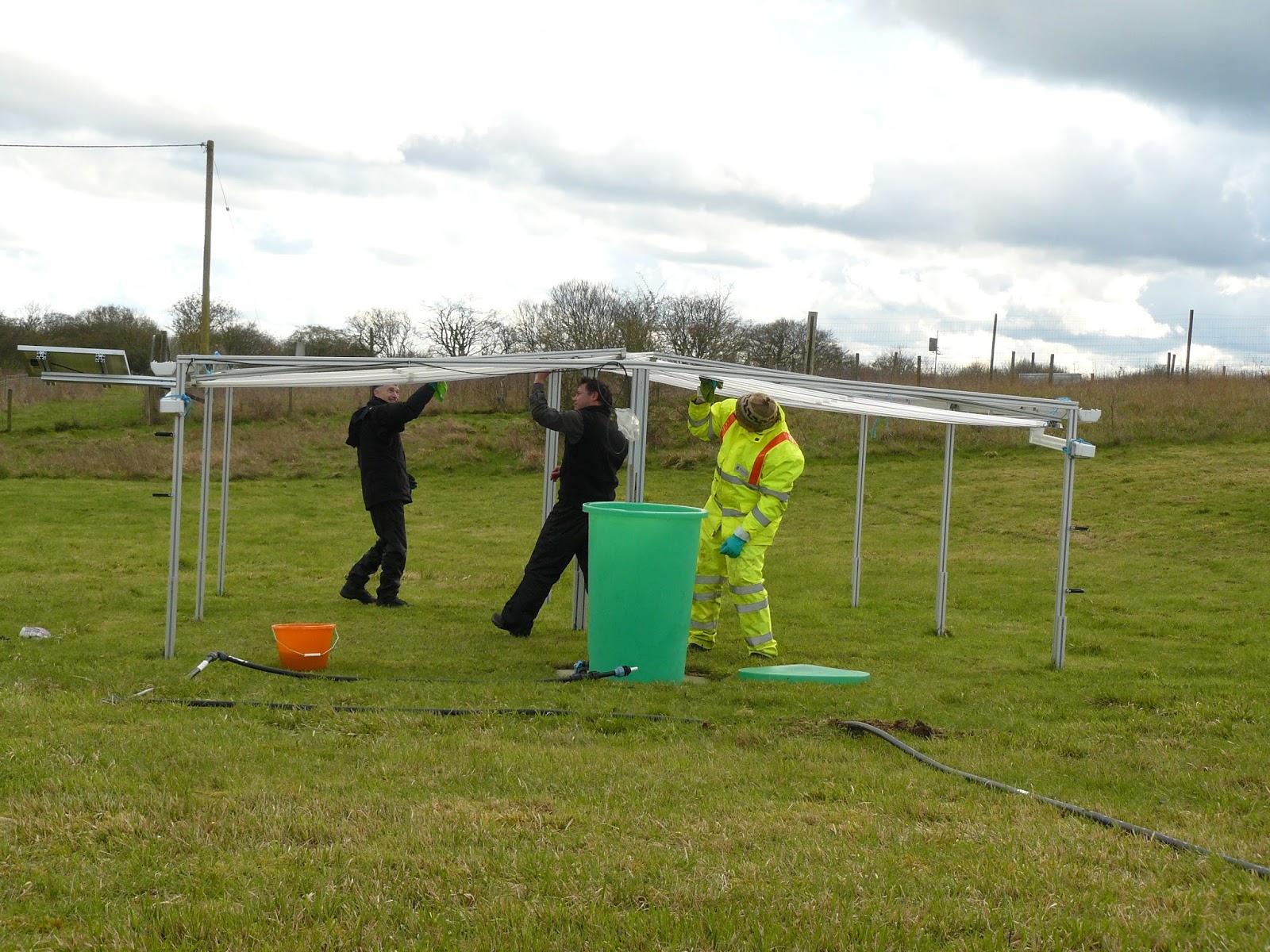
After dismantling the irrigation and decommissioning the rain shelters for the winter months, the long wait is over and it's time to get cracking again. Back in March, I was joined by a handful of people willing to spend some time cleaning the accumulated dust and debris.  All depths were plumbed as we cleaned water butts....

Neil cleaning the water butts

.... washed down guttering.....
Andy, Kadmiel and Neil - useful tall people reach the parts shorter  researchers cannot reach!


.... and checked pumps, batteries and solar panels were all still working properly. 
Becca checking the pump housing and evicting a few beetles while she's at it

 The relatively mild winter meant that some plants had got started early, with hairy violets and cowslips being among the first flowers seen on site this season. 


It also meant that there were scores of overwintering harlequin ladybirds hiding out in all the pipework and basking in the unexpected (but very welcome) Spring sunshine. 

Did I say "scores"?  Hundreds of the little critters were soon swarming around - I had to turf several out of my camera bag when I got home, and several more have taken up freeloading residence in the car since! 

Several hours of sunny showers (including a short shower of hail) culminated in a dramatic rainbow over site, affording some 'ooh' and 'aah' moments to end the day on.  Lovely. 


Monday, 10 October 2016

Irrigation at work


As a change from more still photos, here's a (very) short video of the irrigation working during a site visit:


The sprinkler heads are set to have a 90 degree operational arc, so theoretically the water falls within the experimental plot.  The water for this comes from the storage butts that act as reservoirs for the intercepted 50% rainfall from the droughted plots.  I need to tweak the float switches still, to ensure they're all switching on and off at the same water depth, but otherwise, the system seems to be working so far.

This is something I'll be checking on regularly over the winter, as part of the ongoing monitoring of the site, the system, and the field generally.

Friday, 9 September 2016

Buttercups and bedstraws, mouse-ears and geraniums


These four groups are abundantly scattered over Upper Seeds, and though it's fairly straightforward to recognise them quickly to genus, it can take time to become familiar with individual species, especially when many characteristics are similar.  This first survey season has also been a timely reminder not to assume I know what species I'm looking at, and to take a few minutes just checking some of the finer details to make sure. Time well spent with the small, shy species in grasslands like this!

Buttercups (Ranunculus species)

Always very familiar, with their shiny yellow flowers, and beloved of all pollinators and pollen eaters, these are not always so easy to tell apart without closer inspection.  I've so far identified three species of buttercup here - Small-Flowered, Creeping and Meadow.

Small-Flowerd Buttercup (R. parviflorus) (May 2016)
The small-flowered buttercup really stood out early in the season, as its pale yellowy-green leaves weren't familiar at all.  Mostly growing towards the western end of the field, at the top of the rise, a few localised patches showed up in late May as soft leafy mounds against the otherwise still-short cover before the growing season really got underway.

It's well-named, as the flowers are small and easily overlooked, lacking the shiny in-your-face nature of some of the other buttercups.

Groovy Creeping Buttercup stem

Creeping (R. repens) and Meadow (R. acris) buttercups are possibly the two species most often encountered, and easily mixed up, as they occur together in many meadows and other habitats (I know I have to get down and check these constantly!).

Once they're flowering, there's two main characteristics that tell them apart:  leaf shape, and whether the flower stem is grooved or not.

Both creeping and meadow buttercups have spreading sepals, but creeping buttercups also have a grooved flower stem (this isn't grooved on the meadow buttercup), and have three-lobed leaves where the terminal leaflet has its own short stem  (meadow buttercup leaves are more deeply cut).

One species I expected to find but haven't yet is the Bulbous Buttercup (R. bulbosus) - another shiny yellow-flowered species, but easily told from creeping and meadow by its reflexed (downturned) sepals.

Bedstraws (Galium species)

Another group where I have got three species on site; two familiar faces, and one that is another new one for my personal species list.  Hedge bedstraw (G. mollugo) and lady's bedstraw (G. verum) are quickly differentiated by the width of the leaf blades: hedge bedstraw has much broader leaves, with fewer leaves per whorl along the stem than lady's bedstraw.

Hedge bedstraw - wider leaves, white flowers


Lady's bedstraw - narrow leaf blades, yellow flowers


Slender bedstraw - widely spaced narrow leaves, white flowers
I was happy with these IDs - until the bedstraws started to flower, when I quickly realised I had white flowers on what I thought was lady's bedstraw (which has yellow flowers).  Whoops.  A salutory reminder not to get over-confident!

This surprise species I have now down as Slender Bedstraw (G. pumilum), and the process of looking closer at it has highlighted small but crucial differences from lady's bedstraw.  The flower colour is the really obvious characteristic; beyond that, the leaf whorls are much more widely spaced along the stem, giving slender bedstraw a less robust appearance.  Getting a hand lens out, will show you a few backward-pointing bristles along the edge of the leaves, as well as a lack of the distinctively rolled edges that characterise lady's bedstraw. 

Mouse-ears (Cerastium species)

Common Mouse-ear
Small, white-flowered plants that sparkle between the grass blades and round the side of other plant species; these are the little brothers of Stitchwort, and share the same starry flowers and simple paired leaf arrangements.

Two species on site: Common Mouse-ear (C. fontanum) - ubiquitous throughout the field, hairy but not sticky (see below!), with tiny white flowers and narrow pointed green leaves. 
Crowded terminal flowerhead of Sticky Mouse-ear


I've only seen Sticky Mouse-ear (C. glomeratum)  in one location so far.  It's stickily hairy, and has crowded terminal flower heads.  These, and the broader, more yellow leaves, make it stand out as something different from the common mouse-ear.  This is a plant I'll be keeping my eyes peeled for as time goes on and I get a closer look around my field.


Geraniums

One or other of two tiny pink-flowered species have been popping up in most places, like Little Jack Horner's plums - everywhere I stopped to do a survey, there was a small pink speck demanding I figure out which it is.  Like the buttercups, both these species were found growing closely together, making unravelling which was which tricky while there was still only foliage present.

Two tiny Geranium species (and other things!)
Both with similar, deeply cut foliage, and small pink flowers each with 5 petals - but if you look a bit closer.......

Cut-leaved Crane's-bill
Cut-leaved crane's-bill (G. dissectum) is a more sprawling, hairy plant, with flowers on short petioles close to the main stem, along with a number of leaves, giving an overall rather crowded impression of the flower position.

The petals are notched, and flowers appear to be a slightly deeper pink than the Long-Stalked Geranium (this is much more obvious when you can see them growing together).

Long-stalked Crane's-bill


Long-stalked Crane's-bill (G. columbinum) - is a gracile plant with larger, unnotched, paler pink petals forming individual flowers placed at the end of long delicate stems.  This is also less noticably hairy than the Cut-leaved crane's-bill. 


Just some of the small things that please me about working in grasslands like this.  There are many others, of course, and I hope to document some of those in later posts. 

Wednesday, 17 August 2016

First cut, July 2016

Despite being delayed by sporadically heavy showers, we finally got Upper Seeds mown.  The guys at Wytham did a fantastic job, and left a very tidy field, complete with stripes.  The final stage - setting up the irrigation system and other field "furniture" - could now get going. 

After first cut, July 2016

We left butterfly strips around the field margins, well away from the experimental plots, to support the plant and invertebrate diversity so apparent in Upper Seeds during the Spring.

Butterfly strips were left around field margins

This approach means that early-Summer pupating butterflies and moths wouldn't be completely lost due to this first mowing - this freshly emerged Six-Spot Burnet (below) would have ended up in a silage heap, otherwise!

Six-spot Burnet moth (Zygaena filipendulae)  
The bullerfly strips  also mean that many plant species are allowed to flower, and later to set seed, providing valuable forage for insects and birds. 

Six-spot Burnet feeding on Field Scabious (Knautia arvensis)

Meadow Brown on Smooth Hawksbeard (Crepis capillaris)